
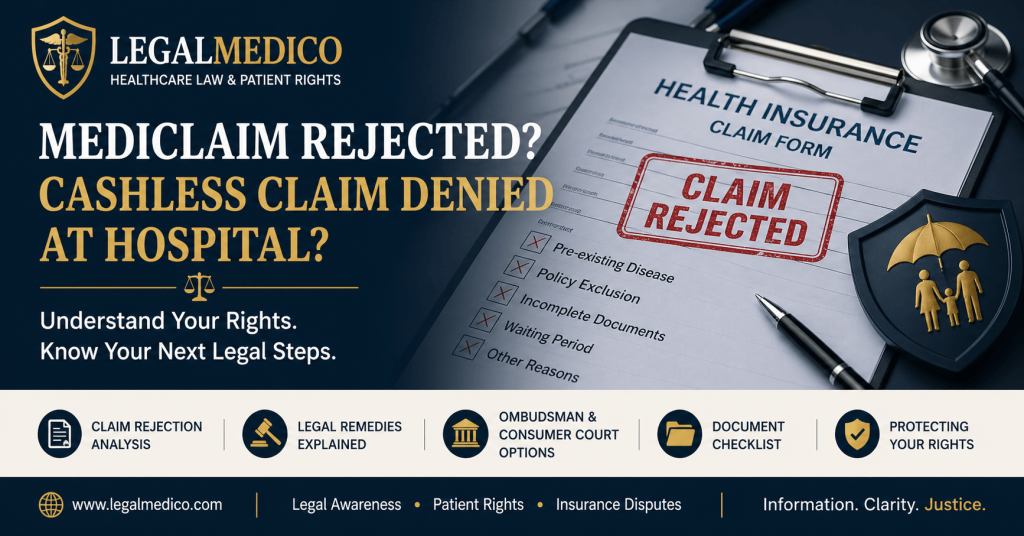
Quick Answer: What Should You Do After a Mediclaim Rejection?
If your mediclaim is rejected, cashless treatment is denied, reimbursement is delayed or the claim is only partly paid, the first step is to identify the exact reason given by the insurer and preserve every document, email, bill and medical record.
Most health insurance disputes fall into predictable patterns: pre-existing disease, waiting period, exclusion clause, document deficiency, cashless denial, group-policy issue, delayed settlement or partial deduction. The right response depends on which ground has been used and what the policy wording and medical record actually show.
The strongest challenge is usually built on four pillars: policy wording, medical chronology, rejection reasons and statutory / regulatory timelines.
The First 48 Hours After Claim Rejection
Save the rejection letter
Do not rely on verbal statements from TPA or call centre. Save the written rejection, partial settlement, deduction sheet or cashless denial email with date and time.
Ask for the exact policy clause
The insurer should identify the exclusion, waiting period, sub-limit, PED clause or document deficiency relied upon.
Collect the complete hospital file
Discharge summary, final bill, itemized bill, investigation reports, doctor notes, implant stickers, prescriptions, indoor case papers and payment proofs should be preserved.
File internal grievance before limitation is lost
For the Ombudsman route, a written grievance to the insurer is generally the first step. Keep proof of submission and reply/non-reply.
Find Your Rejection Reason
Open the situation closest to your rejection letter. The insurer’s exact wording may differ, but most disputes fit into these categories.
Pre-existing disease / non-disclosure rejection
The insurer alleges that the disease existed before policy inception or was not disclosed in the proposal form.
Cashless hospital claim denied
Cashless denial at hospital does not always mean the claim is finally lost. Reimbursement may still be possible if the treatment is otherwise covered.
Waiting period or exclusion clause applied
The insurer relies on a policy exclusion, waiting period, sub-limit, disease-specific condition, non-payable item or procedural exclusion.
Claim delayed or no decision given
Sometimes the insurer neither settles nor rejects the claim and keeps asking for more documents or clarification.
Partial settlement / deductions from hospital bill
The claim is allowed partly, but large deductions are made for room rent, consumables, implants, proportionate deduction, non-payable items or package charges.
Group / employer health insurance dispute
Group mediclaim disputes may involve the insurer, TPA and employer/master policyholder, especially where coverage status, employee data or family coverage is disputed.
IRDAI 2024 Health Insurance Rights That Matter
Cashless authorization timeline
IRDAI’s 2024 health insurance circular framework expects prompt cashless authorization decisions, with the one-hour timeline becoming important in disputes.
Discharge authorization timeline
Final authorization for discharge is a key issue where families are forced to wait at hospital after treatment because insurer/TPA approval is delayed.
60-month moratorium principle
After 60 months of continuous coverage, health-policy claims are generally protected against contest on non-disclosure/misrepresentation grounds except established fraud.
Reasoned repudiation
A rejection should be reasoned and refer to relevant policy terms. Vague rejection language should be examined carefully.
Claim review mechanism
Repudiation or partial disallowance should pass through the insurer’s internal claim-review mechanism as per applicable regulatory framework.
Document handling
After claim intimation, documents available with hospitals and TPAs should be handled responsibly; repeated vague requests can become part of the dispute chronology.
Insurance Ombudsman vs Consumer Commission: Which Route Fits?
Forum choice depends on claim amount, relief required, limitation, compensation needs, urgency, complexity of medical evidence and whether another proceeding is already pending.
| Forum | Best suited for | Limit / timeline | Relief / outcome |
|---|---|---|---|
| Insurer internal grievance | First written step; useful to build record before Ombudsman or further legal route. | Keep proof of complaint and reply/non-reply. | Reconsideration, clarification, settlement or final rejection. |
| Insurance Ombudsman No-fee route |
Policyholder-friendly claim disputes where compensation sought is within Ombudsman limit. | Generally within one year from rejection/unsatisfactory reply/no reply situations. | Award route; insurer-bound if accepted by complainant as per rules. |
| Consumer Commission Compensation route |
Wrongful repudiation, service deficiency, unfair trade practice, delay, harassment and compensation claims. | District up to ₹50 lakh; State above ₹50 lakh to ₹2 crore; National above ₹2 crore. | Claim amount, interest, compensation and costs depending on facts. |
| Civil Court | Complex contractual disputes requiring detailed evidence and trial. | Limitation and court fee depend on case nature and claim. | Contractual reliefs and damages where maintainable. |
| High Court writ | Limited public-law situations, generally involving statutory/regulatory violation by public authority/PSU insurer. | No fixed statutory period, but delay/laches matter. | Discretionary constitutional relief. |
Documents Needed to Challenge a Rejected Health Insurance Claim
A rejected insurance claim is document-heavy. The quality of your document file can change the strength of the complaint.
How a Strong Complaint Is Built
A good complaint is not only emotional. It should be chronological, medical-record-based, clause-specific and forum-appropriate.
1. Facts Timeline
Policy date, premium history, admission date, claim intimation, document submission, rejection and grievance dates.
2. Policy Clause Audit
Identify the exact clause relied on and test whether it actually applies to the medical facts.
3. Medical Evidence
Use treating doctor records, diagnosis chronology and hospital notes to counter assumptions.
4. Regulatory Breach
Map delay, cashless authorization, discharge approval, review mechanism and document-handling issues.
5. Relief Calculation
Claim amount, unpaid balance, interest, out-of-pocket expense, compensation and costs.
6. Forum Strategy
Choose internal grievance, Ombudsman, Consumer Commission, civil court or writ route based on case facts.
Frequently Asked Questions
Can an insurer reject my claim for pre-existing disease?
Yes, but the rejection should be supported by policy wording, medical chronology and evidence showing the specific condition and the basis for non-disclosure. A generic allegation should be examined carefully.
Does cashless denial mean my health insurance claim is over?
No. Cashless denial and final claim repudiation are different. In many cases, reimbursement may still be filed and challenged if rejected.
Can I approach Insurance Ombudsman?
In many insurance disputes, the Ombudsman route becomes available after internal grievance conditions are met and within the prescribed period and monetary limits. The facts and amount involved should be checked first.
Can I file before Consumer Commission instead?
Yes, where the facts and relief justify it. Consumer Commission may be relevant for deficiency in service, unfair trade practice, compensation, interest and litigation-cost issues.
Can the insurer keep asking for new documents repeatedly?
Repeated, vague or sequential document demands can be challenged, especially where documents were already submitted or available with the hospital. The full correspondence trail becomes important.
What if my policy is older than five years?
IRDAI’s 2024 health insurance framework includes a 60-month moratorium principle for health policies, subject to fraud exceptions and applicable policy/regulatory terms. The exact facts should be reviewed.
Sources and Further Reading
Legal Disclaimer
This page is for public legal awareness and general information only. It does not constitute legal advice, medical advice, opinion on any individual claim, solicitation, advertisement, guarantee of outcome or creation of an advocate-client relationship.
Insurance disputes depend on policy wording, proposal disclosures, medical records, claim correspondence, limitation, forum jurisdiction and applicable law. Readers should obtain case-specific advice after full document review.
About LegalMedico
LegalMedico publishes educational insights on healthcare law, medical ethics, insurance-claim disputes, patient rights, hospital compliance and medico-legal developments in India.
Explore More LegalMedico Insights