
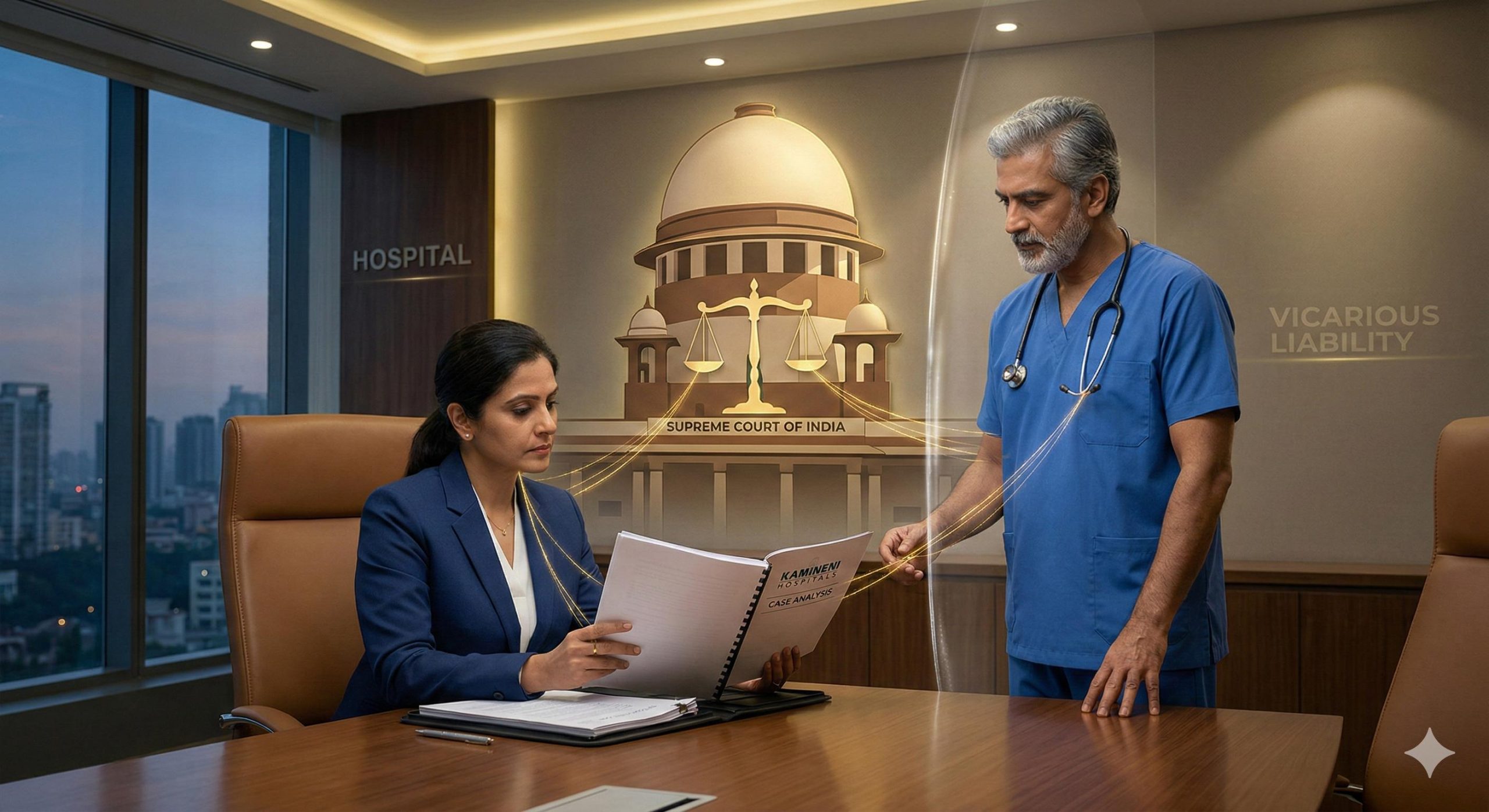
The “Visiting Consultant” Illusion: Why Your Hospital is Now Paying for the Freelancer’s Mistakes
A clinical-legal analysis of the Supreme Court’s 2025 Kamineni Judgment, and why standard 'Revenue Sharing' MoUs no longer protect Hospital Promoters.
Category: Hospital Risk Management & Litigation Defense Author: Adv. Lokesh Bagani Read Time: 5 Minutes
1. The Administrative Blind Spot
Walk into the boardroom of any mid-to-large corporate hospital in India, and you will find a common operational model: The hospital provides the infrastructure (OT, ICU, Nursing staff), and “Visiting Consultants” or “Freelance Surgeons” perform the procedures on a fee-for-service or revenue-sharing basis.
For years, Hospital Promoters slept peacefully under a specific legal assumption: “If the visiting surgeon makes a clinical error, it is their liability, not ours. They are an independent professional, not our employee.”
As of April 2025, the Supreme Court of India has fundamentally dismantled this defense.
2. The 2025 Precedent: “Patient Perception” over Private Contracts
In a landmark ruling delivered in April 2025 (Civil Appeal concerning a major corporate healthcare entity), the Supreme Court addressed the death of a patient due to alleged medical negligence. The National Consumer Commission (NCDRC) had imposed heavy compensation on both the treating surgeon and the hospital management.
The hospital management appealed to the Supreme Court, arguing that the clinical error was solely the responsibility of the treating freelance doctors, who were independent contractors, thereby requesting the court to exonerate the corporate entity.
The Supreme Court dismissed this defense and held the hospital Vicariously Liable.
Why did the Court rule this way?
Courts now apply the doctrine of “Ostensible Agency” and the test of “Patient Perception.” When a patient walks into your facility:
-
They register at your reception.
-
They sleep in your IPD bed.
-
They pay a consolidated invoice generated by your billing department.
The Supreme Court essentially stated that if the hospital “holds out” a doctor as competent enough to use its OT, the hospital implicitly guarantees that doctor’s standard of care. You cannot share the revenue of a surgery but disown the clinical outcome. Your internal MoU stating the doctor is an “Independent Contractor” holds very little weight against a grieving family in a Consumer Forum.
3. The Procedural Antidote (Deep Nursing Home Shield)
While the April 2025 ruling expanded the liability of hospital owners, another subsequent Supreme Court ruling (Deep Nursing Home vs Manmeet Singh Mattewal) offered a powerful defensive mechanism.
In this case, a Consumer Commission had penalized a nursing home by inventing new grounds of negligence that the patient had never even mentioned in their original complaint.
The Supreme Court struck this down. The Court ruled that adjudicatory bodies cannot go on a “fishing expedition.” They are strictly bound by the exact allegations written in the patient’s pleadings.
-
The Clinical Translation: If a patient’s legal notice specifically alleges “Anesthesia Overdose,” the judge cannot arbitrarily penalize your hospital for “Poor ICU Hygiene” if it wasn’t pleaded.
This makes the initial drafting of your defense incredibly critical. If your legal counsel can successfully restrict the “Scope of Pleadings” at the very first hearing, you drastically reduce your hospital’s financial exposure.
4. The “Treatment Protocol”: Fixing Your Doctor Contracts
The era of the simple 2-page “Terms of Engagement” or “Revenue Share MoU” is over. To protect the hospital’s balance sheet, Administrators must immediately upgrade their legal architecture.
Here is the three-step compliance fix:
-
Move from “Engagement” to “Privileges”: Stop using employment or engagement contracts for freelancers. Transition to a “Grant of Clinical Privileges Agreement.” This legally defines that the hospital is merely allowing the doctor to use its facility, provided they strictly adhere to the hospital’s internal Standard Operating Procedures (SOPs).
-
The Cross-Indemnity Clause: Your contract must explicitly state that if the hospital is sued for the specific clinical judgment of the visiting doctor, the doctor will indemnify (reimburse) the hospital for those damages.
-
Insurance Alignment: It is no longer enough to ask, “Do you have indemnity insurance?” You must legally mandate that the Visiting Consultant’s Professional Indemnity Policy specifically covers actions taken within your hospital’s geographical premises. If their insurance company denies the claim because your hospital wasn’t listed, your hospital will end up paying the compensation.
Conclusion
A hospital is not just a building with medical equipment; in the eyes of the law, it is the ultimate guarantor of patient safety. By auditing your visiting consultant agreements today, you prevent a clinical complication from becoming a corporate financial disaster tomorrow.
Statutory & Content Disclaimer:
This article is a jurisprudential analysis of publicly available judgments delivered by the Hon’ble Supreme Court of India. It is intended solely for academic, educational, and informational purposes for healthcare administrators and legal practitioners. The references to any institutional frameworks are strictly contextual to the cited judicial records and do not constitute any independent finding of fact, allegation, or disparagement by the author.
Furthermore, in strict compliance with the Bar Council of India Rules, this publication does not constitute legal advice, solicitation, or an invitation for an attorney-client relationship. The application of law varies based on specific facts, and readers are strongly advised to seek independent legal counsel before acting upon any information contained herein. The author assumes no liability for any reliance placed on this material.Author: ADV. LOKESH BAGANI | MBA, LLB, LL.M. (Cyber Law – Pursuing)